Tuesday, July 25, 2006

Shivering lives: in need of heroic readers (more than heroes)

xp@LS

    "A man is rich in proportion to the number of things he can afford to let alone."


Some  readers may have already seen Benjamin Kunkel's essay  in the Sunday Book Review (bugmenot), in which he writes, among other things:

What Thoreau has to overcome during his time in the woods is not a lapse in mental health.  His great problem is to escape the mental health of his neighbors, their collection-plate opinions, their studious repetition of gossip.  Thoreau isn't against self-esteem (he admires a friend who has learned to "treat himself with ever increasing respect"); but his main task is to lose his esteem for society in which "trade curses everything it handles" and the singular natural resource of time is wasted in barren productivity.  Maybe he had vices out there in the woods, but that's not his concern, or ours.  The overwhelming impression is of his philosophical ardor, which he tries to fuse with his practical ardor.  There's not a note in the book of self-pity, or nostalgia.  And why did he quit his cabin in the end?  "It seemed to me that I had several more lives to live."   This accent of futurity is missing among contemporary memoirists.  They sigh over their past woes; sigh with relief now that they're better; or sigh the long sighs of nostalgia. (emphasis added)


Indeed, and not just among contemporary memoirists, but also American Presidents.

Anyway, I would like to concur, alongside Marco Roth, that in the current marketplace of literature's ongoing infantilization the legacy of the "heroic reader" may be something we can not afford to let alone.

The paradox of the heroic reader would seem to be, quite simply, that she must actively distance herself from the sick world (that is, submerge herself in the very limitless task, in the important and non-trivial stakes of reading, with all the terror this implies), in order to re-enter society with both sincerity and sympathy, and with an attention–dare we call it philosophical–to living (zoe) as opposed to mere endurance of the "safe" thrills of organized spectacle or pre-packaged experience.

Surely it is no exaggeration to imply, as Roth does, that overbrimming with "fresh talent" today that all looks the same (literally, with the same attractive author photo in the back of each new novel), literature and its would-be critics have lost sight of something crucial in "succumb[ing] to triumphal capitalism."  Increasingly light and harmless, overbrimming with clichés masquerading as novelty, or with pat and wildly simplistic explanatory formulas seemingly designed to grant the overworked Starbucks citizen access to a freshly flatte(n)(r)ing worldview, merely updated for the latest toys or accessories to self, you might say, (or in this case, conversation soundbites), and without posing a threat to either complicity or complacency, or for that matter challenging her critical and independent intelligence as literate, world citizen...even the new "seriousness" today remains–in short–philosophically impoverished.

This is not to suggest that philosophy and the "heroic reader" are purely synonymous, obviously.  But for a while the literary critic, and lit theory in particular (if one goes back and actually reads it now, as one site where philosophy had temporarily sedimented)–did keep alive and remain faithful to this utopian impulse.  Here is Roth (subscription only):

We live in a cloud of vague dangers, neither clear nor present.  Unelected judges appoint our president, and a man in a suit (once a Greenspan, now a Bernanke) determines whether stocks, prices, and unemployment rates rise or fall.  Consent is all that is asked of us, or suspension of disbelief.  And it seems that our ever increasing supply of fictions does nothing but abet the cultivation of this decadent passivity, and idealogical apparatus all the more insidious for not belonging to the state.

This criticism of readers is as old as prophetic castigations of idol worshippers.  The concern has usually been that reading will lead to wrong actions or no action–to immorality or passivity.  So Wordsworth thought that the surge in popular novels and plays at the beginning of the industrial revolution had plunged English minds into "savage torpor."  He recommended we read more to cure ourselves–more Wordsworth.  Novelists too wrote against the wrong kind of novels and the wrong kind of readers.  This remains one of the strongests unsettled legacies of the long tradition of the modern novel, from the era of the French revolution, through Flaubert and Tolstoy, up through today.

The rescue of readers from their own pernicious tendencies must be counted among the many utopian projects of the past two centuries, and, like nationalism and communism, it gained an accelerated force at the beginning of the 20th.  The the evident aesthetic and political failures of socialist realism onward, novelists, critics and teachers have stuggled to create readers whose aesthetic sensibilities would trigger their social responsibility and, if lucky, their mental liberation.  Sometimes readers were to be dragged out of their everyday slough by an array of estrangement effects.  At others, they would find freedom and enlightenment through an understanding of the arbitrary nature of conventions governing language and narrative action.  The rise of "literary theory" was aligned with these utopian hopes and movements.  Looking back now, we can see the 20th century as the golden age of the reader as hero.

Where did this figure go?  Like so much else, the heroic reader has succumbed to triumphal capitalism.  We look around and find that we are in a consumer's world.  Even those who supposedly "care" for literature have turned themselves into fans and enthusiasts.  Does such and such a novel keep it real?  Does it pique curiosity?  Do I identify?  Do I like the sound of this voice in my ear?  The idea of the reader as canny consumer is so pervasive that one editor of a prominent literary magazine writes about herself as a member of "the service economy" and compares criticism to waitressing.  It was undoubtedly a moment of weakness.  But still:  is a taste for literature nothing more than a refined palate?  Is literary criticism really like being able to tell which wine tastes of wet stone and which of tart blackberry?

Banished by Amazon preferences and litblogs, the heroic reader lingers on as a memory mostly confined to academic criticism.  Pick up the lit theory of the late 1960s and early '70s:  There's Stanley Fish's vision of Paradise Lost as great test and trap for its Protestant readers; Frederic Jameson's liberation theology, in which readers bring the political unconscious of novels into the light of day; the stoical struggle of Paul de Man's "rhetorical" reading, in which the self must learn to deny that it is a self; and, most self-consciously heroic of all, Harold Bloom's quest to arrive back at "the great cyclic poem" by imagining poets as the best and most active unconscious misreaders.  It makes sense that academic literary criticism would carry a torch for "higher reading," since these people have devoted themselves to the belief that reading is the most important thing we do.

Of course these theories never made it into broader American culture.  (There was once a plan to have Andrzej Warminski, Gayatri Spivak, and a team of graduate students teach rhetorical reading in New Haven public schools, but it's not mentioned now without an embarrassed laugh.)  For a while, however, there were two complementary "heroic reader" theories that did make it.  These weren't necessarily the most rigorous or the most captivatingly "heroic," but they were the most directly American.  They offered a sense of reading that tallied with ideas of what it means to be a good citizen in a liberal democracy.  One proposed to enlarge our sympathies; the second would teach us how to overcome our own Romantic impulses and reach emotional and intellectual maturity.

The first theory was once an axiom of liberal-arts education back when we had liberal-arts education:  reading novels could be "good for you"; it could even improve American morals.  You didn't learn anything from novels exactly, not useful knowledge, not information necessarily, certainly not the Truth, but the right kinds of novels were supposed to act as a check on our freedom and selfishness by educating readers into sympathy with others.  There was always something horrifying and terrifyingly banal about this assumption.  Horrifying because it tried to socialize the wild imagination of readers–especially those young readers most likely to experience literature as liberation from the limitations of place, time, social codes, their own gender, race, and class, their families, or morality itself.  Terrifyingly banal because once you'd learned to read the educated way, a lot of the illicit thrill went out of reading novels.  The novel just wanted you to behave.  There's an analogy with the present cult of diet and exercise:  the boy who runs through the grass until his lungs burn and the world looks both brighter and darker becomes a calorie counter and times himself in the mile.

The most thorough defenses of what David Bromwich nicknamed "literature as moral vitamins" appeared on the scene in the late 1980s and early 1990s, a time that can now be seen as the death throes of American liberalism and the liberal arts.  (Then, it was thought of as a mere crisis period; the enemies were presumed to be the antiliberal left and French theory, rather than fundamentalists, demagogues, and rampant consumerism.)  Richard Rorty and Martha Nussbaum both attempted to make the case for reading novels as socially desirable and even necessary activity for a society that would be both good and just.  For Rorty, the relation of reader to novel and also of author to character demonstrated the kind of solidarity that could hold secular and democratic countries together even if we accepted that truth was unknowable, shot through with irony and contingency.  Nussbaum thought novels could offer revisions to liberal utilitarian calculations.  They would rehumanize a technocratic elite and teach them to account for exceptions to teh sort of generalized rule-making that prevailed among professional ethicists and lawyers.  Not just any novel would do, of course.  A canon was available and it appeared to be a closed one:  adapted, with variations, from F.R. Leavis's older "Great Tradition," it often sounded like Austen, some Dickens, George Eliot, and Henry James.  Instead of Leavis's favorite, D.H. Lawrence, Rorty substituted Nabokov and Orwell; Nussbaum offered Beckett and also stepped back to Shakespeare and the ancient Athenians.  One because an ethical reader, in short, by reading ethical writers–writers devoted to the task of creating charactgers who were, as much as possible, autonomous.

Despite this late attempt to rescue the liberal view that, in John Dewey's phrase, "art is more moral than moralities," the model already had encountered serious opposition.  Crucially, it bred a feeling of superiority among novel-reading liberal-arts types that had first been exposed during the '60s revolt of the antiliberal left.  It turned out that characters who existed in novels as objects of sympathy (put-upon women, poor people, colonial subjects, prisoners) had ideas of their own about life.  They didn't want sympathy, they wanted power.  And so, at the high school level, the whole post-1968 model of reading for group empowerment and identiy formation supplanted the cult of sympathy and developed into niche marketing (chick lit, anyone?).  On the political level, the short-lived triumph of minority politics was followed by the long counter-revolution in whose shadow we've spent our lives.  One of its major triumphs has been the careful corruption of minority "Yes We Can!" rhetoric of empowerment into an excuse for majority bullying.  Liberals are now told that corporate bosses, policemen, and politicians have feelings that must be respected; that we must care for the strike-breaker, the prison guard, and the executive's wish for privacy.  To do anything else would be elitist.

But would it be uncivilized?  Becoming a responsible citizen and even an adult is precisely about knowing when to judge and condemn and when to sympathize and care.  Yet how does one know that is real, what romantic?  What a true judgement and what an act of faith or misplaced trust?  To try to answer these questions, the second type of American heroic reader was called forth in the aftermath of World War II amid a host of European influences.  In his 1948 essay "Art and Fortune," Lionel Trilling argued that we needed novels to make us feel fully alive; he proposed that we read novels precisely in order to re-experience a developmental process and win our way to full adulthood.  The aim was to achieve knowledge without loss of power, but with a recognition of limitations.

The right new novels in the hands of the right new readers could bring about a change, a synthesis in the ongoing "dialectic of reality and illusion."  In Trilling's account, the novel that best staged this multi-layered dialectic between worldly and literary experience was Stendhal's early-19th century "novel of ideas," The Red and the Black.  In the character and fate of Julien Sorel, Trilling saw the heroic readers of the future as well as hope for novesl.

For Trilling, when Julien borrows a gardener's ladder to climb into the bedroom of his boss's daughter, with a pistol in his pocket and a knife, pirate-style, between his teeth, he rises to the level of a novelistic objective correlative.  Within a single action, Stendhal captures the farcical elements of Liberal France in the 1830s, a culture in which a young man's dream of romantic heroism had been degraded to one of upward mobility.  Julien isn't just an idea himself; however, later in the novel, as Trilling reads it, he becomes exactly the adult enlightened reader who learns to recognize his past actions as misguided–motivated by the pursuit of "specious goods."  Julien, though, doesn't quite make it.  (He gets bored of the aristocratic girlfriend he's seduced, but he never manages to figure out what he wants.)  And that failure too is a parable.

This kind of reading, let's call it allegorical transumption, depends on the reader's will to pass through identification into interpretation; call it a will to grow up.  This reader–while we're at is, let's call him he–with his novel (and friends to argue about it) would be allowed fantasies of seductions, rope-ladders, murders, strapping men, and women "inall ways shapely"–the trappings of old romances endlessly updatable for new situations.  But he would also have to understand that these demons must be sublimated into thoughts and arguments about the state of the world and the condition of his life.  By plunging into the lives of fictional others will all reckless abandon, he'd yet emerge clutching a pearl of greater price, a fuller understanding of himself, his motives and wishes.  He'd do this not necessarily to act on them, but to bring them to light and expose them to a world shared with others.

Both the will to interpret and the will to grow up flagged in the '60s, epitomized by Sontag's essay "Against Interpretation" and its argument for endless surface textual pleasure.  Sontag's call for an "erotics of art" anticipated and echoed sexual liberation's promise of eternal youth as well as the growing suspicion of psychoanalysis.  Yet, against Sontag, we can once more recognized hermeneutics as a kind of erotics, albeit more Civilization and Its Discontents than "zipless fuck."

Despite our culture's best efforts–from left and right–the liberal hero-readers of both the "moral vitamins" and "allegorical transumption" accounts can never be fully liquidated–even when History itself seems to have no more use for them.  They've been driven underground in a curious inverted repressed, but they may return as characters again.  No character returns unchanged from the underworld or from exile.  We shouldn't expect our new heroic readers to be as innocent in their quests for spiritual upward mobility as their many precursors.  The liberal hero is different from Emma Bovary, Anna Karenina, or Don Quixote–those overly active readers betrayed into becoming characters in someone else's novel–but there's still a story to tell.

A contemporary novel that could dramatize the life of one heroic reading consciousness or even one reader's struggle between heroic reading and the impulses so effectively tapped by consumerism might just be the sort of novel to save us from our own savage torpor.  It would still be a novel, of course–just as Anna Karenina remains a novel critical of novels and already points the way to Tolstoy's ultimate renunciation of art.  The struggle would have to be set in one of the great metropolitan centers of our global commercial culture, New York or London.  Curiously, it seems difficult to write anything but minor novels and satires about these places now.  It used to be that the metropole was defined as the place everyone went to write and the plave everyone wrote about.  The former still holds, for the most part, but the metropolis now lies shrouded in myths of its boringness, its unrepresentability.  The inhabitants of these places who want the news from novels get "realist" writing purchased from developing countries or America's expanding borderlands and hinterlands.  We metropolitan readers have lives no less reall for taking place withing this history of reading.  Let us turn the gaze upon ourselves, if only the better to focus it again.


So then, not a call for yet another Great American Novel, exactly, but a demand to write conscious of history, nonetheless.  It is indeed an antiquated and perhaps "terrifyingly banal" assumption (not to mention, somewhat residually patronising and patriarchal), that literature may provide not only more than a business, more than a merely "safe and fun" activitity (on airplanes, say), but also equipment for living.  But is throwing out this legacy (call it "Theory," or call it both T.S. Eliot and Derrida, or call it Nussbaum and Trilling), really the only possible, wisest response to (American) liberalism's demise?  What might still be worth retaining, in its commitment to openness and a certain sense of futurity, especially, not to mention courage....It is, I think, an entirely appropriate and prudent question.

another stupid political post

You know the tides are swirling thick when even bedrock loser like William F. Buckley makes an opportunist splash, noting how poorly it reflects on Bush's character and all, that he has not yet voluntarily resigned.

Right, because thinking people the world over had always pegged Bush the next George Washington. It's only been that long.

Funny also, how F. Buckley is now referenced as some old and noble figure of integrity, calloused and wayward yet refined dignitary of some thing (from back when "conservatives" were not all pea-brained, "Jesus"-loving, bat-shit crazies). In truth the man was a complete fucking prick, a nasty and annoying snob with a truly vicious and cruel dominating side, not least of all when it came to those many decent and free-thinking professors he tried, relentlessly and unapologetically, to smear into oblivion and financial ruin, as either gay or "communist" (or both), back in the day.

(Most likely now he simply feels–like many Eastern conservatives–left out of the loop. The ruling fundamentalist junta of Texans and Exxon crooks probably ignores him.)

Parrhesia

On this vain blog, it is a series; in the world that is the case, it is another sign of hope. From the editors' intruduction to the inaugural issue (via via):
‘Parrhesia’, as Foucault explains it, is a word which comes into prominent use in the democratic moment of the classical age. It is used first extensively by Euripedes in the second half of the fifth century, before it comes to occupy a more central place – and to become a hotly contested issue or possibility – in the political texts of the period (‘Fearless Speech’, pp. 78-83), and the philosophies of Plato (pp. 83-86, 91-107), Aristotle (pp..86-7), and the later Hellenistic period. (107ff.)
The topic of parrhesia which occupies Foucault’s last works on parrhesia, we would argue, has an incredible ‘timeliness’ for us today, in a world where our leaders talk about spreading democracy abroad while, to all appearances, it is increasingly questioned an curtailed at home, hemmed in by both legal changes and the emergence of new forms of populism and what Isocrates would have called kolakes (‘flatterers’). (p. 82, see pp.13-4) The issues surrounding the cassus bellum in Iraq, the unprecedented secrecy of today’s US administration or its increasingly public advocacy of torture, and (in Australia) the litany of causes celebres from the children overboard to the AWB, have raised the issue of the relation between truth-telling and politics with all the freshness with which it evidently presented itself to Isocrates, Plato, or the pseudo-Xenephon.

We see here a parallel with the work of Walter Benjamin. Like Foucault, Benjamin’s body of thought was devoted to the necessity of thinking the past through the crisis of the present. Benjamin was however concerned with the ways in which history consistently obliterated those moments and movements who thought of the possibility of utopian futures. As he stated in one of his earliest published works “The elements of the ultimate condition do not manifest themselves as formless progressive tendencies but are deeply rooted in every present in the form of the most endangered, excoriated and ridiculed ideas and products of the creative mind.” For Benjamin true critical thought wasn’t the product of the institution, a sanctioned reflection on the present. Excoriated it is thought that is constantly threatened and challenged as its seeks to uncover new truths, emerging out of a specific context, but searching for the possibility of shattering the petrified continuum of the present.

In essence, this journal takes as its aim the elaboration of the many problems that rest upon this self-context relation in the sense that Foucault analyses it. We are not here concerned with ‘telling the truth’ in the mode of the classical thinker, that is, as the members of our culture whose fortune or birthright it is to claim objectivity in judgement. In fact, as Foucault himself indicated so thoroughly, this position of objectivity is itself a matter for examination – Jacques Rancière’s article in this first edition engages with the same concern. We are concerned to examine the forms and problems of the various modalities of relationship. One consequence of this is that aesthetics can no longer be considered a well-demarcated discourse concerned with art narrowly conceived.

Subjectivity, not given but a part of the movement of socio-political contexts, is itself to be composed. In a similar vein, ethics loses its sense as the discourse of inalienable rights, or of moral codes, but must instead express the various modes interaction with oneself and one’s context. Again, politics must be understood no longer as the analytic of society, but must be broadened to include the various modes of individuation, subjectivation and counter-subjectivation.

The broadest goals of Parrhesia are to pursue the various knots which occur between these discourses, the knotting of concerns relating to doctrines of the subject an aesthetics, between aesthetics and politics, politics and ethics, and so on. While this is clearly a very large set of concerns considered together, we are convinced that it is at these points of knotting that active and critical thought is best disposed in our contemporary context.

Tuesday, July 18, 2006

Woody Guthrie on PBS (he was)

Curious what Max has against Despite Joe Klein, appearing briefly here (that middle link being the closest this blog will ever come to mentioning a certain ridiculously behind the times and over-the-hill mealy-mouthed and pious, fascist-compromising smughole, corporate welfare lacky/crazed militarist/soon-to-be-"independent"in-more-ways-than-he-wishes Senator from New England). Update: yup.

Friday, July 14, 2006

awkwardness unto death

The Sick New World embraces anti-mourning's latest prop, huggable urns, the radio informs...


But leaving that, where we found it, this is a rare confessional post about animal friends, specifically dogs, their being-unto-death philosophically considered, somewhat, and other things.

Essay

So many poems about the deaths of animals.
Wilbur's toad, Kinnell's porcupine, Eberhart's squirrel,
and that poem by someone–Hecht? Merrill?–
about cremating a woodchuck. But mostly
I remember the outrageous number of them,
as if every poet, I too, had written at least
one animal elegy; with the result that today
when I came to a good enough poem by Edwin Brock
about finding a dead fox at the edge of the sea
I could not respond; as if permanent shock
had deadened me. And then after a moment
I began to give way to sorrow (watching myself
sorrowlessly the while), not merely because
part of my being had been violated and annulled,
but because all these many poems over the years
had been necessary,–suitable and correct. This
has been the time of the finishing off of animals.
They are going away–their fur and their wild eyes,
their voices. Deer leap and leap in front
of the screaming snowmobiles until they leap
out of existence. Hawks circle once or twice
around their shattered nests and then they climb
to the stars. I have lived with them fifty years,
and now they are going, almost gone. I don't know
if the animals are capable of reproach.
But clearly they do not bother to say good-bye.

-Hayden Carruth, Brothers I Loved You All (Poems 1969-1977)


(Roger wisely recommends the above, and I have to agree.)


Keeping with the spirit of indirectly or barely thinking posts, I had planned on mentioning at least in passing Carruth, one of Vermont's finest poets, and this in lieu of a long and self-indulgent list of anecdotes about a friend who was a dog–a sister or daughter (and of course, mother, as all female dogs especially without pups are) of sorts; named "Sheena" though sometimes known simply as "my girl"–who passed away last week, lying in the summer night beneath a piano, having not eaten for three weeks. She often resembled in expression, somewhat uncannily, the animal pictured on the cover of Grenier's book (which I had read long ago, and should like to re-read now). Only the tiniest bit more blunt-nosed and muttish, curly-haired, retrieverish, perhaps.

Her will was strong, and she was I think sad, and reluctant unto death–as most are. As for "the end"–whenever this moment is ascribed–I suppose it was peaceful–as most people try to make themselves believe. And it was, at least in the sense that she had been awaiting death to (not)come, and probably died in her sleep, of a heart-attack or something similar (after consciousness had faded, I wish to believe).

She had lost her appetite, most likely as result of cancer–she was 16 (older than some), and we didn't do the expensive testing, tests that could only lead to more expensive and invasive treatment. We fed her on tuna oil, sardines, hamburgers and bread for as long as she would have it (mainly trying to keep her in fluids, and so as comfortable as possible). I confess to wishing for a drug, something to make her feel absolutely great–or at least no discomfort–one last time. To give her that gift–one last new experience/realm of pleasure–as a sort of inadequate thanks, but mostly just for her. But it wasn't to be.

The next morning her bony body was wrapped in a blanket and buried, in a spot she had chosen only days before (secluding herself away there by the garden, before being found and brought back inside one last time–we weren't ready yet). She had witnessed, such as dogs are able, the passing of two others (in that very house), but she was the first to go naturally (and the first not to be cremated). While not visibly in pain, by the end could barely lift her head. Or so I hear.

Having said imperfect goodbyes, I was off to do that Nature thing again, whereby one speedwalks through the woods (this time suburb-smelling woods), up mountains and by national civic memorials and massive powerlines in thunderstorms with a heavy pack of tasteless food, sweats rivers and drinks painstakingly filtered water, massages aching feet and sleeps in stuffy, 70-year-old shelters with other grimy and unshaven, snoring sweating people. People requiring a minimum of acknowledgement, but most often nice enough. People for whatever reason having decided to forsake the Starbucks world for seven months or so. Or rather, to forsake it for a week of swollen feet at a time, to binge on pizza, beer and hamburgers one fine anyday (or, in our case, other people's wedding cake and booze). Strange form of torture, this routine of binge and asceticism. Difficult to maintain in good spirits (Thoreau he was a pathologic liar)–once it becomes like any job, no longer novelty. Or so I hear.

Anyway owning and enjoying my own grumpiness somewhat, while hiking fast, was nothing terrible, and often the sensation of hiking was pretty great. Being cluster-bombed by aircorns at five in the morning, in a shelter with a metal roof, was even pretty great. The guilty chipmunk family, who are certainly legends by now, do it mostly for the sport, I wager, to provoke and tease the tired people into lurching furiously out and hurling back, which is entirely futile of course. Throwing anything one hundred feet in the air to much effect is strenuous and pointless work, and anyway they only fall back on the roof again.

Returning driving all through the night, at first mostly with trucks, the smells were distinct from state to state. Pennsylvania, warm mixture of wood (or something) burning and cow manure. One could sense their mood, the truckers, happily just fed, primed for the night (or was it the final push?–so many pulled off by the early morning, like logs before a river damn). The familiar rushing by of New Jersey and New York, windows down and radio blaring its preemptive alarm clock. (Should I stop? I should stop, and see so-and-so. No I'll keep going. Too late to call now; no time anyway.) Around New York, radio stations from Canada come in. Early morning on the American highway, reading billboards despite oneself, cultivating an interior and aloof, vague cynicism or rather numbness, at the spectacle of all this, tinged with the comfort of familiarity. Looking forward, perversely, to the toll-booth and the assurance of an encounter with someone more miserably bored than oneself, from whom you get to drive away, accelerating back to ticket-tempting speed in that moment of urgency before the dullness returns. Maybe change the station, light a cigarette. (No, not really, no more of those for me; I dislike everything they do to me, and in the immediate term they're just not pleasurable anymore. So I quit for the third time, having never really started up again. A part of this, admittedly, being the dagger looks from a certain other, earlier when she was in the drivers seat, and the car nearly left its tires on the road.) Somewhere between three and five the air cools to a chill at last, and the windows go up.

"Black eyes," is what I sometimes called her. For a period of several years, we were extremely close, possessive and overly-protective of each other, even. At middle age, she was convinced to chase sticks just deep enough to swim for the first time (always with that little Kierkegaardian leap dogs sometimes do, before losing her footing to the abyss), and to sneeze on command (or talk, and occasionally sing). Blond border-collie mutt, easily excitable, intelligent and sensitive, stubborn and neurotic, always performing 'work.' But also patient. Later in life, her eyes had that unconditionally adoring, happy look when sitting at attention, staring at my efforts in the garden these past few weeks from wherever she was planted (sometimes just so that her head was visible–she seemed proud of hiding herself this way, as if watching sheep in secret).

She may not have intended it, but her familiar gaze, in the absence of speech, often cleared a space for a certain silence in my life. Or maybe, performed a sort of witness (at once comforting and neurotic), to a relation with a silence that never belonged to anyone. A silence that has been torn from me now, by her departure.

How I admire films that don't avoid a certain silence, that attempt to speak alongside this silence without resolving it, in ways both more originally didactic or aesthetically documentarist. Or in a more metaphysical vein, always, Tarkovsky.

My speech is a warning that at this very moment death is loose in the world, that it has suddenly appeared between me, as I speak, and the being I address: it is there between us as the distance that separates us, but this distance is also what prevents us from being separated, because it contains the condition for all understanding. Death alone allows me to grasp what I want to attain; it exists in words as the only way they can have meaning. Without death, everything would sink into absurdity and nothingness. (Blanchot, The Work of Fire, 323-24)


And what of the mass anonymous graves being dug and filled, as we speak, in Lebanon (or rather just outside the city walls), as Israel continues its civilian massacre with U.S. motherfucking blessing. How will the work of mourning take place there?

Not at all without first shedding our current "leaders," obviously, and their delusional, triumphalist and dogmatic, paranoid and expensive slumber, or rather sleep-driving SUV limosine rampage, in which our very democratic immune system has been drugged into destroying itself.

Friday, June 30, 2006

Descartes Chomsky

Speaking at West Point [RealPlayer], in April on Just War Theory...

For a more critical, albeit general take, on Chomsky (if one were interested), one might see here, and here. And just in case it wasn't clear, I agree with all necessary caveats, giving respects where respects are due.

In any case this metafilter thread picking up on the Foucault/Chomsky "debate" that has been (re)making the rounds lately, begs the necessary corrective (tho stupidities continuing to have popular purchase is hardly news, and time is better spent showing instead of telling, and in other forms, I fully realize):
What's the most widely held misconception about you and your work?

That I'm a skeptical nihilist who doesn't believe in anything, who thinks nothing has meaning, and text has no meaning. That's stupid and utterly wrong, and only people who haven't read me say this. It's a misreading of my work that began 35 years ago, and it's difficult to destroy. I never said everything is linguistic and we're enclosed in language. In fact, I say the opposite, and the deconstruction of logocentrism was conceived to dismantle precisely this philosophy for which everything is language. Anyone who reads my work with attention understands that I insist on affirmation and faith, and that I'm full of respect for the texts I read.


More thoughtful, original posting, hopefully, in about a week (it is (other peoples') wedding season, and hiking time again).

Godard

is apparently, by mainstream jerk-off standards, "alive and kicking"

Wednesday, June 28, 2006

La Jetée


Courtesy of Dan Visel.

not by man alone

Listening to Coltrane, ballads (thanks to Eric), on a rainy day. Reminded, that sentimental Baker sings a version of this one.

Democracy, meanwhile, is maybe an old man listening too hard. He is trying to feel..profundity–as it were. And so missing feeling–and the putting at risk–altogether.

If only fitting back into one body were so easily accomplished.

Reading on America, Tocqueville and Nancy.

Tuesday, June 27, 2006

Reconstruction, har har (sure, why not)

Alexandra Heifetz:
...Among the real philosophers and career academics, things are worse. In 1989, Brian Leiter, now an analytic philosopher and law professor at the University of Texas at Austin, declared open war on continental philosophy by launching the Philosophical Gourmet Report. In the PGR, Leiter offered a ranking of the top philosophy programs in the US. At first hard copies of the rankings were distributed; then in 1996 the PGR went online. Geared toward prospective undergrads and based on the “quality of faculty” factor, the rankings were clearly, profoundly biased toward analytic programs. Some continental-leaning departments hung near the bottom of the list; most didn’t make it at all.

On the PGR website, which is now very fancy, there’s a section called “Continental vs. Analytic Philosophy,” a concise version of the introduction Leiter wrote for the book A Future for Philosophy. Here he distinguishes between them as two styles of doing philosophy, rather than categories for the kind of books to be read:

Continental philosophy is distinguished by its style (more literary, less analytical, sometimes just obscure), its concerns (more interested in actual political and cultural issues and, loosely speaking, the human situation and its “meaning”), and some of its substantive commitments (more self-conscious about the relation of philosophy to its historical situation).


Leiter seems to think he’s dropping a bomb—note the disparagements of “obscure” and “loosely speaking”—but the house of philosophy had begun to self-destruct half a century before. Since the 1950s analytic philosophers have made the same complaints: that continental philosophy has a messy literary quality, that it wastes time with “concepts-in-quotations,” and that it bothers itself with cultural things like genocide and the Internet. And yet, boom! Like a frantic seven-year-old, Leiter defends his kind of philosophy by pushing out people who don’t agree with him.

Not all continental scholars are concerned with historicity. Some are: the postmodernists, the feminists, the critical race theorists. But what the continental has tried to preserve (and what the analytic has tried to run from) is a sense that, even while pursuing self-preservation, philosophers should never give up on answering questions that are important and interesting to everyone. The analytic philosopher takes his scalpel to the concept of democracy; the continental presents us with an account of the brutal pacification of the east. One is not more philosophically interesting than the other, but certainly the second is more interesting to real people. And after all, there are still real people asking questions—for instance, the undergraduate who takes a course on ancient Greek philosophy and wonders why the platonic philosopher-king banished poetry while on television presidents use the highly poetic rhetoric of wartime. In universities with hard-core analytic cliques, like NYU or Princeton, continental philosophers end up outside of the philosophy department and find a home in comp lit, women’s, or African-American studies. In those settings they won’t be the ones to teach classes on the western philosophical tradition, and the task of teaching the ancients (and the recents) is left to the analytic philosophers. In their classrooms, “meaningful” words are more important than rhetoric, “sophomoric” everyday questions are banned, and in place of natural curiosity a student learns pragmatic methodology.

Continental philosophy isn’t obsolete. But the continental education, that ideal classroom in which Wittgenstein and Foucault are both taught, is becoming very difficult to find. This should worry us more than the fates of individual graduate students, whichever gang they choose. Today’s missiles are being dropped east of the Holland House Library.


Food for thought, as one revisits such things in turning to America.

Update: It has come to my attention that this polemic, excerpted above in the general interests of Internet communism, may be, as indeed polemics often are, slightly unfair, in this case to Brian Leiter, and furthermore that it may even contain factual inaccuracies of one degree or another. Please feel free to read his partly tangential, partly confirming, in any case blustering reply (linked several times by one "anonymous" soul in comments below) and come to your own well-nuanced and adult conclusions as always, needless to say.

Update 2: Also, dear fellow "random morons" if you will: please do take a look at this, and this. Thanks.

Sunday, June 18, 2006

SAGP

A placeholder (light posting for a spell)

More and more and more on global warming. One thing consistently bothering me about the whole Gore book/movie exposé/presentation is that he never seems to emphasize the implications of a delayed response – that it takes roughly 40 years (though this may be decreasing as things accelerate) to register the effects of current emmission levels, etc. You might think, then, that the fact things are melting exponentially faster practically by the year would be cause for even greater concern, that is, when realizing that whatever we do, nothing will begin to improve for at least forty years! What we are seeing now, in Gore's footage, is the direct consequence of our actions forty years ago. We have no idea how much worse it's going to get, only that it will be exponentially so, and inevitably (at least for n + 40 years). And so on. Oedipus, indeed.

Naturally the very possibility, that no matter what we do a new Ice Age may be coming (at least for Europe) is, how shall we say, a prospective truth a tad too inconvenient for any politician to dare emphasize. Better to just go home, buy that hybrid car, praise the adaptability of capitalism, and pray.

A translation.

• An interview.

• Jodi Dean on Theory Blogging.

• A disturbing article (via). And, meanwhile...speaking of whom.

• A typically excellent post by Michael Bérubé (how very common and tired, the "dissenting" straw man so habitually beloved of conservative opportunists does become). Bérubé's still riding Chomsky, too, for those of you wishing to have that debate (go there).

• So much for Civil Rights, say the reactionary ruling class, bunker-headed politicians (for those of you interested in tomorrow's news).

• A discussion ongoing, with interesting...tangents.

Happy Father's Day (to the tune of Dylan's #7 installment)

Monday, June 12, 2006

they're talking Schmitt

Very good discussion ongoing, at that Eclectic Australian/American/Canadian/French/Italian/Swedish/Brit blog, as you know. Germans more than welcome too, as it leaves the blog economy of interest orbit altogether, becoming-journal..

Tuesday, June 06, 2006

Foster Wallace

From an interview, courtesy of wood s lot (link to latter of which being hardly necessary):
Look, if the contemporary condition is hopelessly shitty, insipid, materialistic, emotionally retarded, sadomasochistic, and stupid, then I (or any writer) can get away with slapping together stories with characters who are stupid, vapid, emotionally retarded, which is easy, because these sorts of characters require no development. With descriptions that are simply lists of brand-name consumer products. Where stupid people say insipid stuff to each other. If what's always distinguished bad writing--flat characters, a narrative world that's cliched and not recognizably human, etc.--is also a description of today's world, then bad writing becomes an ingenious mimesis of a bad world. If readers simply believe the world is stupid and shallow and mean, then Ellis can write a mean shallow stupid novel that becomes a mordant deadpan commentary on the badness of everything. Look man, we'd probably most of us agree that these are dark times, and stupid ones, but do we need fiction that does nothing but dramatize how dark and stupid everything is? In dark times, the definition of good art would seem to be art that locates and applies CPR to those elements of what's human and magical that still live and glow despite the times' darkness. Really good fiction could have as dark a worldview as it wished, but it'd find a way both to depict this world and to illuminate the possibilities for being alive and human in it. You can defend "Psycho" as being a sort of performative digest of late-eighties social problems, but it's no more than that.

LM: Are you saying that writers of your generation have an obligation not only to depict our condition but also to provide the solutions to these things?

DFW: I don't think I'm talking about conventionally political or social action-type solutions. That's not what fiction's about. Fiction's about what it is to be a fucking human being. If you operate, which most of us do, from the premise that there are things about the contemporary U.S. that make it distinctively hard to be a real human being, then maybe half of fiction's job is to dramatize what it is that makes it tough. The other half is to dramatize the fact that we still "are" human beings, now. Or can be. This isn't that it's fiction's duty to edify or teach, or to make us good little Christians or Republicans; I'm not trying to line up behind Tolstoy or Gardner. I just think that fiction that isn't exploring what it means to be human today isn't art. We've all got this "literary" fiction that simply monotones that we're all becoming less and less human, that presents characters without souls or love, characters who really are exhaustively describable in terms of what brands of stuff they wear, and we all buy the books and go like "Golly, what a mordantly effective commentary on contemporary materialism!" But we already "know" U.S. culture is materialistic. This diagnosis can be done in about two lines. It doesn't engage anybody. What's engaging and artistically real is, taking it as axiomatic that the present is grotesquely materialistic, how is it that we as human beings still have the capacity for joy, charity, genuine connections, for stuff that doesn't have a price? And can these capacities be made to thrive? And if so, how, and if not why not?

Friday, June 02, 2006

Thursday, June 01, 2006

The Leiter Industry

Matt Christie
to Brian Leiter Aug 31 (23 hours ago)
From: Matt Christie Mailed-By: gmail.com
To: BLEITER@law.utexas.edu
Date: Aug 31, 2006 4:23 PM
Subject: please correct your post

Mr. Leiter-

While I understand your feelings of umbrage, which are indeed in this case to some degree justified, if not also desiring to be an institution unto themselves: if you are going to resort to calling names, and specifically to calling myself and those who frequent my site "random morons," twice now I do believe, kindly at least have the courtesy to link properly to my post!

Unless, of course, you are afraid for what free-thinking people may actually find?

I look forward to your productive participation in our upcoming symposium on Derrida, and in particular on the articles appearing in SubStance Magazine.

Yours bemusedly,

MC

Chris Marker

Films not yet seen:

- Chris Marker : Les Statues Meurent Aussi (1953, 30mn.)

- Chris Marker : Sunday in Peking ( 1956, 22mn.)

- Chris Marker : Dimanche à Pékin (1956, French Version, 22mn.)

- Chris Marker : Letter from Siberia (English version. 1957, 62mn.)

- Chris Marker : Description of a Struggle / d’un Combat (1960, Hebrew with english AND french subtitles, 60mn.)

- Chris Marker : Cuba Si (Original french version, some Spanish… 1961, 52mn.)

- Chris Marker : La Jetée (english or french version – 1962, 28mn.)

- Chris Marker : Al Valparaiso (English subs. 1962, 34mn.)

- Chris Marker : Le Mystère Koumiko (subtitled –1965, 54mn.)

- Chris Marker : La sixième face du pentagone (Original french version, 1968, 28 min.)

- Chris Marker : The Train Rolls On (1971, 32mn.)

- Chris Marker : The Embassy (English Version. 1973, 20mn.)

- Chris Marker : Sans Soleil / Sunless (english or french version – 1982, 110mn.)

& / Chris on Chris (documentary, 10mn.)

- Chris Marker : A.K. The Making of Ran (English Version 1985, 71mn.)

- Chris Marker : Le Tombeau d’Alexandre / The Last Bolshevik (1992, 2 x 60mn.Fench & english versions)

- Chris Marker : Level Five (English Subtitled. Upgraded ! 1997, 110mn.)

- Chris Marker : IMMEMORY CD-ROM (1997, hours of exquisite delights ! French PC)

- Chris Marker : One Day in the Life of Andrei Arsenevitch (1999, 55mn.)

- Chris Marker : Chats Perchés (2004, 59mn) / Petit Bestiaire de Chris Marker includes 5 shorts : Chat écoutant la musique, An Owl is an Owl is an Owl, Zoo Piece, Bullfight in Okinawa & Slon Tango (26mn.)

- Chris Marker : Les Groupes Medvekine Box set : Chris. Marker et Slon etc. Coll. 243mn. On 4 DVD un-compressed : À bientôt, j’espère, La Charnière STDK, Classe de Lutte, Rhodia 4/8, Sochaux 11 juin, Les trois quart de la vie à Sochaux, Avec le sang des autres, Septembre Chilien

- Chris Marker : Olympia 52 (1952, 82mn.)

- Chris Marker : Owl’s Heritage (1989, 13x26mn.)

Any recommendations?

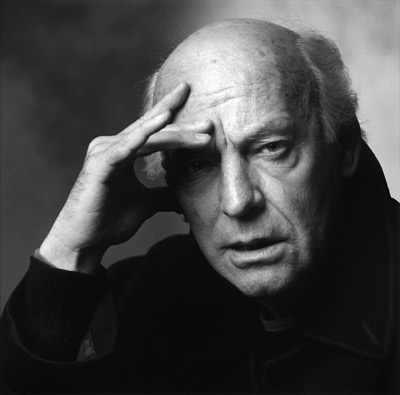
Eduardo Galeano


I was curious about Eduardo's new book of stories, having heard some things in the news lately. So, I decided to buy a copy.

Not here, precisely, but sometimes he looks rather like John Malkovich.

Latino Boom

Good news for literature is sometimes worth repeating. The recently released Latino Boom (now with its very own website!) is a unique and unprecedented anthology of Latino fiction, poetry, short stories and drama, and by all accounts an essential volume for any teacher in the complex and growing field. Or for that matter just any lover of literature. Anyway I've had the chance to read through a good portion of it, and it really is very good.

From the preface:
Latino Boom presents some of the best Latino Literature from the past 20 years. As the first anthology of its kind to supplement its selections with contextual background materials, it also maintians a holistic approach that distinguishes it...Based on our own firsthand experience as teachers...this work has been tested where it counts most...
Indeed, I can vouch for this, as one of the editors is my brother.
By maintaining this focus on recent writings, dating from 1985 to the present, we have been able to concentrate upon works in four major genres–the short story, poetry, drama, and the essay–and include selections our students have often found most enjoyable and fascinating. Yet we want to emphasize the fact that this anthology presents only the tail end of a long tradition of writing by Latinos, one that stretches back to the European conquest of the Americas in the early 1500s, and much of it written in Spanish.

Beyond the need to limit the scope of the book, we have chosen to concentrate on the modern period because it offers some of the richest literary achievements that have substantially changed the landscape of Latino writing. After all, it was not until the late 1980s and early 1990s that the labels themselves–Hispanic American literature and Latino literature–came into common use. All over the United States, prolific young Latino writers are reinventing the literary landscape. The explosion of South American literary works in the 1970s and 1980s–a period referred to as the "Latin American Literary Boom"–is now mirrored in the U.S. Latino literature.

Focusing on contemporary works also allows us to broaden the book's range to include Latino authors who have been underrepresented in anthologies and other collections, namely women and other less–well-known writers from a wide range of ethnic and cultural backgrounds. With an eye toward looking at works in their entirety, we have avoided excerpts from longer fiction such as novels. There are a few exceptions to this general guideline, however: Sandra Benítez's "Fulgencio Llanos: El Fotógrafo," and–it could be argued–Edgardo Vega Yunqué's "The Barbosa Express" are both stories and individual chapters in genre-bending novels composed of a series of connected short stories.


It's got a lovely cover, doesn't it?

In very short, the anthology renders a complex period bravely accessible, while steering admirably clear, in its conception, of such things as over-simplification and easy polemic. The approach is deeply pedagogical and literary, with careful outlines of various schools of reception, and detailed engagement with such questions as revolve today around narrative and autobiography, just to name a few. There is throughout a very native, deeply polyglot sense for this literature's often hybrid, heterogeneous origins and currents. As such, it is also a collection with a very real social conscience, and obviously unafraid to grapple with issues of cultural and historical context (there are wonderful, detailed maps and admirably unflinching, politically objective timelines detailing various U.S. invasions throughout the years, and so on). Needless to say, however, the literary is nowhere sacrificed purely to questions of mere politics. All in all, a highly original, and admirably-contextualized compilation. Clearly an indispensable volume not only for teachers, but for anyone concerned for the future of literature in the 21st century. There will no doubt be much more to come (provided, of course, we are to survive, to some day read about it, and in places other than the NYTBR.).


nb. Might I also direct your attention to some very wonderful scans, perhaps of related interest: A Nation of Poets: Writings from the Poetry Workshops of Nicaragua (courtesy of Mark Woods).

Wednesday, May 31, 2006

New International (v)

(nb. This post following on from here, and spurred on by AK's remarks today on "the ownership society," among other things.)

Foucault, of course, does not finally evade the label of "intellectual." All typical bad press (unless one is well-paid for hackery, of course) notwithstanding, he describes his role, in a rare candid moment, in the essay, "Useless to Revolt?" as follows:
...one must at the same time look closely, a bit beneath history, and what cleaves it and stirs it, and keep watch, a bit behind politics, over what must unconditionally limit it. After all, that is my work; I am not the first or the only one to do it. But that is what I chose. (Le Monde, 1979)


He is also optimistic. More precisely, thus:
There is an optimism that consists in saying, "In any case, it couldn't be better." My optimism would consist rather in saying, "So many things can be changed, being as fragile as they are, tied more to contingencies than to necessities, more to what is arbitrary than to what is rationally established, more to complex but transitory historical contingencies than to inevitable anthropological constants..." You know, to say that we are more recent than we thought is not a way of bring the whole weight of our history down on our shoulders. Rather, it is to make available for the work that we can do on ourselves the largest possible share of what is presented to us as unaccessible. ("So Is It Important to Think?" Libération, 1981)


But what I really wish to draw your attention to, dear patient reader, is this (on the occasion of "the announcement in Geneva of the creation of an International Committee against Piracy"....well whatever that was):
We are just private individuals here, with no other grounds for speaking, or for speaking together, than a certain shared difficulty in enduring what is taking place.
[...] Who appointed us, then? No one. And that is precisely what constitutes our right. It seems to me that we need to bear in mind three principles that, I believe, guide this initiative, and many others that have preceded it: the Île-de-Lumière, Cape Anamour, the Airplane for El Salvador, Terre des Hommes, Amnesty International.
1. There exists an international citizenship that has its rights and its duties, and that obliges one to speak out against every abuse of power, whoever its author, whoever its victims. After all, we are all members of the community of the governed, and thereby obliged to show mutual solidarity.

2. Because they claim to be concerned for the welfare of societies, governments arrogate to themselves the right to pass off as profit or loss the human unhappiness that their decisions provoke or their negligence permits. It is a duty of this international citizenship to always bring the testimony of people's suffering to the eyes and ears of governments, sufferings for which it's untrue that they are not responsible. The suffering of men must never be a silent residue of policy. It grounds an absolute right to stand up and speak to those who hold power.

3. We must reject the division of labor so often proposed to us: individuals can get indignant and talk; governments will reflect and act. It's true that good governments appreciate the holy indignation of the governed, provided it remains lyrical. I think we need to be aware that very often it is those who govern who talk, are capable only of talking, and want only to talk. Experience shows that one can and must refuse the theatrical role of pure and simple indignation that is proposed to us. Amnesty International, Terre des Hommes, and Médecins du monde are initiatives that have created this new right––that of private individuals to effectively intervene in the sphere of international policy and strategy. The will of individuals must make a place for itself in a reality of which governments have attempted to reserve a monopoly for themselves, that monopoly which we need to wrest from them little by little and day by day. ("Confronting Governments: Human Rights," Libération, 1984)

Just imagine, governments! Humoring the advice of its citizens? Hoarding realities? Monopolies on reality? Whatever was he on about.

That was 22 years ago. Thoughts now safely pronounced obsolete. (After all, the world is flat.) Surely, you say, the late Foucault is all just talk, talk, talk!

"Say it out for God's sake and have done with it."

Said William James to Henry.

And:
You never have music here, do you.
It makes me nervous.
-David Markson, This is Not a Novel

Is this latter a quote?

"How frequently was Anon. a woman?"

And:
An anthology of extraordinary suicide notes.
Or of any suicide notes. Is there such?
-David Markson, This is Not a Novel


Well, is there?

Tuesday, May 30, 2006

Haditha Friedman

Lest it need be said, Haditha is not an abberation.  Only let's remember too, the folks who helped put us there.  If one only ever reads five things about Thomas Friedman, hack, let four of them be these (please click).

Tom Friedman
Tom Friedman
Tom Friedman
Tom Friedman

This bout of profoundly transformative netroots activism brought on by experiences mentioned in the post updated, below. Or maybe it was learning of Iraq's My Lai (here's Murtha one and two; and here's something even more honest). Or was it Afghanistan's My Lai. Whatever that means.  (We cite it precisely because we don't yet know.) 

One thing we do know:  a lot of people once quit the military because of (perceived) anti-soldier sentiment.  They went on to live longer, more complicated lives.

Monday, May 29, 2006

Save the Internet, George Plimpton's ghost, and other things

If you need a laugh...watch the video of novelist and comedian Robert Newman's "History of oil" (courtesy of This Space).

As Moveon.org implores us all to mention, watch it while you can. ((Though apparently, after a social weekend, I get all these highfalutin memos a day late.) In any case do save the Internet, dear legion readers in Congress, if you will.)

A (non-Congressional) reader helpfully writes in:
Yeah, it's potentially a big deal. I hope the efforts of the telcos to defeat net neutrality legislation will fail, and the excellent bill in the house to make price discrimination by ISPs an anti-trust violation will pass. But if it goes the other way, the big media giants could one day soon exert the same financial dominance over the net that they do over all other media channels -- TV, radio, music, print,

The problem is that while use of the net is a level playing field to players of all sizes today, it is already perturbed by the advantage giants such as google have in soaking up all the ad revenue, by virtue of their enormous central database, which gives them a huge information advantage. But at least they deliver something of value. Cable and ISP providers are sheer parasites, just trying to muscle in on the gravy.

A big telco and cable providers just use their monopoly control over the last mile to your home (and their collusive control over the cell phone market) to rake in high prices for slow acess that doesn't get faster, because there is no real competition. We could have had fiberoptic cables to the curb, and free nationwide wireless, by now, but they block any efforts to innovate on a large scale that would threaten their business models. They are poison. And make no mistake about it, all the voices on the side against net neutrality are bought and paid for by consortiums of telcos and media giants.

What they want is a precedent that allows them to charge differentially. Like the way United Airlines charges two people different prices for the same seat, based on how much the market will bear. They figure you have to fly tomorrow, you can be made to pay 10 times the price of someone who can wait until nest week. This is simple larceny, because it has no bearing on their cost of producing the service. But it will allow them to decide who prospers (their partners of course) and to skim a huge per centage of the profits from an industry they are actually retarding rather than helping. Rather like the music publishing industry. If we let them get a foothold in the net arena it's very very bad. If we don't they are probably doomed in the long run to technological obsolesence. Hence their desperate measures.

Of course the "we" in question here has, in truth, very little say in the matter, if at all. The ritual self-flattering of the over-informed and powerless "citizen" (assuming our reader is not a millionaire, i.e. effectual citizen) does grow rather stale, and practically by the minute.

But what to expect, really, in a world where activist dynasties increasingly rule the day, and must contend only with businessmen who sometimes acquire politics, like a hobby.

I attended a graduation over the weekend. The speaker was a young, well-meaning, neoliberal Senator, unapologetically, uncritically, and rather solely inspired by the repulsive folk-posturing, fauxnaif pop-wisdom, the tired euphorias and banal soundbites, the simplistic and irresponsible, excusing cocktail fantasies of renowned opportunist pro-war hack, Tom Friedman. Though somewhat more literary than Friedman (a questionable accomplishment) his speech was a tired insult to intelligence and global citizenship, and ideologically repulsive (it probably goes without saying). Forcing one to wonder, yet again, if ever in the history of political life have those in power been so philosophically impoverished.

Well yeah, you say, at least Al Gore, in his sybaritic retirement, has "just discovered" Habermas. ("Why hadn't I heard of him before?" Gore asks. We wonder too.) And if Foucault can make an appearance on President Sheen's bookshelf...then maybe there's hope yet. Not for our politicians to be thinking men, but at least for their children's pop-culture to one day grow out of Baudrillard. Still there has to be a better way. (Until then, it's cardboard platitudes, and if we're very lucky, a dash of Habermas.)

But speaking of The Bill of Far Rights, The New York Review of Books has reprinted Orhan Pamuk's speech.
But to change one's words and package them in a way that will be acceptable to everyone in a repressed culture, and to become skilled in this arena, is a bit like smuggling forbidden goods through customs, and as such, it is shaming and degrading.


I am currently stuck, half-way through The New Life. Which resides on top a half-read This is Not a Novel, atop a half-read Reckoning with Life, atop a mostly re-read Politics of Friendship. Et cetera. (Unnaturally, but essentially, I despise this sort of bland and personal, dare one say habitual confession/lit-blog listing/excuse for a post. As should you. Blogs that become predictable are of little use to the imagination; they remain parasitic on a sick beast (most political/"professional" and literary blogs are so). Well at least it's not an ill-conceived lecture (though fast becoming one).)

Most important, the George Plimpton project has launched a Haiku contest:
Judged by Billy Collins, David Lehman, and Denise Duhamel.

The haiku should be somehow related to or inspired by the life or
work or philosophy of George Plimpton*.

The Grand Prize is $200. (cash!)

The Deadline is September 15, 2006

Submissions should be sent to toby@plimptonproject.org.

Do not be fooled by the seemingly whimsical nature of the contest,
haiku of serious and thoughtful tone will be weighed with the utmost
respect.

Submissions should be sent to toby@plimptonproject.org

*We suggest you investigate his books (Paper Lion, Shadow Box, Out of My League, etc.) his great and legendary publication "The Paris Review" and his minor appearances in TV and Film (Reds, Good Will Hunting, The Simpsons.) You could also wait for the upcoming oral biography of Plimpton, which is scheduled to come out next spring and promises to be an excellent read, but by then the deadline for this contest will have passed. Or, you could simply listen to the winner of The George Plimpton Song Contest, Jonathan Coulton's excellent composition "A Talk With George." Check it out here.

(kind courtesy of Toby Barlow)

Wednesday, May 24, 2006

Bob

The reticent one. And strange beautiful (thanks for that).
"Don't you ever just sit, man?"

Not being aware his birthday was just around the corner..."Masked and Anonymous" again the other night. A good bad movie, of course (and obviously, outrageously so). Is it insulting? Or flattering? Eh.
The long spanning, unapologetic, documentary camera's gaze, odd without guilt, on Katrina-like crowds of ordinary suffering, poor people. Even when hurrying, solitary and waiting (for the miracle to come, maybe)...an unapologetic tempting of cliché, but given the closeness to reality, not-quite sentimental gazing. The glimpses into Dylan's gently subdued movie-personality (as always, playing the cryptic cowboy), a certain enigmatic patience with the oddness of people and things, prodded along by bits of ironic (though hardly cynical) folk-sounding wisdom...such things were noted. And how he upstages everyone, almost without trying.

Wood s lot expresses typical good taste in recommending this by Brian Doherty. To which one may as well add this by David Hayes.

Monday, May 22, 2006

pharmakon

From Blanchot, "The Pursuit of the Zero Point" (1953):
Literature is only a domain of coherence and a common region as long as it does not exist, as long as it does not exist for itself and conceals itself. As soon as it appears in the distant presentiment of what it seems to be, it flies into pieces, it sets out on the path to dispersion in which it refuses to be recognized by precise, identifiable signs. As, at the same time, traditions remain powerful, humanism continues to seek the assistance of art, prose still wants to fight for the world, there results a confusion in which, at first sight, one cannot reasonably try to decide what is at issue. In general, limited causes and secondary explanations are found for this disintegration. The blame is laid on individualism: each writer is said to write in accordance with a self whose purpose is to be distinct from all others.[1] Blame is also laid on the loss of common values, the profound divisions in the world, the break-up of ideals and of reason.[2] Or else, to re-establish a little clarity, the distinctions of prose and poetry are restored: poetry is consigned to the disorder of the unpredictable, but it is noted that the novel nowadays dominates literature, and that the latter, in the novel form, remains faithful to the everyday, social designs of language, remains within the limits of a circumscribed genre, capable of channelling and specifying it. The novel is often said to be monstrous but, with a few exceptions, it is a well-bred, highly domesticated monster. The novel is identifiable by clear signs which do not lend themselves to misunderstanding. The predominance of the novel, with its apparent freedom, its audacities which do not imperil the genre, the unobtrusive reliability of its conventions, the richness of its humanist content, is, as formerly the predominance of formally regular poetry, the expression of the need we feel to protect ourselves from what makes literature dangerous: as if, at the same time as its poison, literature urgently sought to dispense for our benefit the antidote which alone allows its untroubled, lasting consumption. But perhaps what makes literature innocuous also spells its doom.

In answer to this quest for subordinate causes, we must reply that the break-up of literature is essential and that the dispersion to which it is succumbing also marks the moment at which it approaches itself.


1. There are none the less complaints about the monotony of talent and the uniformity or impersonality of works.

2. But there is virtually nothing which, in literary terms, distinguishes the Catholic novelist from the Communist novelist, and the Nobel prize and the Stalin prize reward the same practices, the same literary signs.


-Maurice Blanchot, translated by Ian Maclachlan, in Michael Holland, ed., 144-45.

A supplement.

it's the radio


lovable old fart

Sunday, May 21, 2006

After The Academy/Jargon (#772)

Professor VJ on Poly-Ticks (just something found browsing referrer logs to LS):

It's funny, but whenever I start talking about digital narrative and the use of new media technologies, most colleagues in the field immediately want to start talking about the available technologies that are being experimented with and then, once they have their tech-jargon credibility established, they inevitably drift into mimicking the by-now canned theory that has been established around the tech-jargon. And yet, when it comes to discussing the actual formal innovation of the narrative, the meaning-making apparatus that defamiliarizes the story being told, or the way a work constructs identity or digital persona, most of the time the interlocutor's eyes get that "glazed over" look of "I have no idea what you're talking about" and an attempt is made to get back on track -- and in this case, on track means referring to the by now established techno-theory that somehow informs the development of weak new media art created for the express purpose of justifying that techno-theory's existence. Of course, this approach is back asswards and just like most of That 80's Show gender and identity politics killed the potential of art in the worst of possible ways, now new media art is quickly beginning to show its structurally insecure spots as well. This essential weakness in the international new media scene has made it less palatable to a lot of artists I know who first got their start in this field, myself included. How to break away from this institutionalization, academicization, and "scientificating" [scientific-pontificating] that is now suffocating so much of the new media arts?

The first thing you have to do is break the cycle of co-dependency. This means that you may have to diss the academy, diss the scientific community, and even diss a good portion of the curatorial apparatus and/or festival directors who are busy building their sand castles so that they can attract funds to pay for the mega-events they are coordinating. That's not easy, especially when networking is such an essential element of the new media art scene. And when there is a lot less pie to go around than in the mid-to-late 90s, and the pie that is being made is oftentimes only possible thanks to the largess of mainstream academic, scientific, and governmental organizations (and in the US, there's very little of that to go around), the cycle of co-dependency creates lots of competition to become even trendier so that you and your work will stand out as the newest of the new media artist-trendsetter crowd.

[...]This is not to say that there are not new media artists who use the Internet space for largely political purposes. Think of the work of The Yes Men or even a straightforward comix artist like Tom Tomorrow. I use my forthcoming book META/DATA (MIT Press, 2007) to suggest alternative approaches to working in and with new media that will enable us to break out of the academic, scientific, and commercial molds that are debilitating the formerly refreshing and fruitful potential of this networked media art scene. Basically, my premise is that a great deal of the work being created in the new media art and theory fields is being wrapped up in an institutional straitjacket that is neutering our ability to have any real effect on the world we live in and that a great many new media artist-theorists are falling into this trap by willingly buying into the same forms of co-dependency that the predominantly academic-scientific communities have bought into long ago. In META/DATA, I don't address this issue dogmatically, wagging my finger at those who buy into the Big Lie, but by doing an end-run, mixing spontaneous theories with avant-pop fictions and self-effacing pseudo-academic essays that read more like poetry remixes than argumentative papers.

To my mind, this is all connected to one's political agenda. What does it say about your professional network, especially one so tied to the First Amendment like the artistic and academic communities are, when the huge symposiums and conferences that bring them all together, collectively ignore the big elephant in the room. And I mean ELEPHANT. The question is: How To Be A First Amendment Patriot while maintaining a healthy anarchic attitude toward organized politics in general? In the past, what made America unique among nations, was its practical implementation of the Bill of Rights. But now it looks as though we're giving it all up to those who would rather dictate a patriarchal Bill of Far Rights.

Except for the occasional sideshow, don't expect to find this as the primary point of discussion at any new media conferences or festivals.

Wednesday, May 17, 2006

Tuesday, May 16, 2006

not mourning yet

Maybe I'm poorly versed in the "conspiracy theories" of the day, but I always thought the real question concerning the plane that hit the Pentagon wasn't whether it was a plane, that hit the Pentagon, but why it circled 270 degrees 'round to the side least likely to do harm. That just don't make sense. (Update: It seems I am poorly versed. By all indications - and this latest "proof" now hardly assuring otherwise - it was a cruise missile that hit the Pentagon (see comments). Well that's not cool. Who would do such a thing?)(Update II: Ellis Sharp begs to differ. The questions about Flight 93 are the most openly begging, I agree. Although there are certainly others, financial and diplomatic and having to do with various explosions causing steel buildings to self-demolish, all included.)


Thursday, May 11, 2006

Weinfield Minefield, no longer

RSB alerts us to new translations of Mallarmé. This is exciting news.

Wednesday, May 10, 2006

state of: lost gravity, dreams vanish into day


Of course sometimes a blog is but an impoverished wunderkammer. A place to collect diverting 'things', or a semi-public (because always partly encoded) museum, of potential notes and sorts, fanciful and gay projections, postcards of future thoughts. (Good blogs sometimes must revisit themselves and seek, at least, to remain faithful to this potential, in my (perhaps unpopular) view. Even if only to declare like poor, endearing Krapp with his ginger, salty pride: "ach...drivel" or "stupid young bastard." Blogs that don't revisit tend to wear thin. While bloggers may not keep their promises, those that forget their promises as soon as they are made – indeed that make them precisely in order to forget – are boring. And that is to invoke both things, forgetfulness and boredom, in the very much banal or 'weak' sense, surely.

While boredom hasn't been an explicit theme here very often, still like the border collie's tilted ear, or the circuitous, Socratic polishing of an ever-elusive and slippery truth, or the more practiced, loving motion of an oily rag 'round the circumference of a certain glass, occassionally shaken until it snows...oh nevermind! Ray Davis will have understood.

I've been on vacation this past week, hiking countless miles, above treeline and within occasional reach of complacent, feral ponies. I've been walking ridges in the windswept clouds, with a million-pound backpack (and that's not even close to the price). How joyful to feel one's limbs, the surging of blood. The care of the body no longer mere nuissance, but rather an art. To look simultaneously within and significantly across, and down; Shopenhauer and progeny they would applaud!

Anyway, more postings shortly. Suffice to say, the Appalachian Trail is a good thing-in-the-world, and the woman I love is happily ensconced in its warm and friendly grip, not to be released 'til mid-summer. That I get to visit, often (and more often as she walks closer), choosing the most beautiful parts to share, is frankly, perfectly okay (as far as compromises go). A different rhythm to relations; indeed we've taken again to writing letters, in between.

I will say these few things:

Instant coffee (specifically of the Folgers, tea-bag variety) ought not be mixed with oatmeal and grapenuts, and then seven kinds of freeze-dried fruit, including pineapple.

Thru-hikers do not walk, they march (or rather, speed-walk, and down hills run).

Thru-hikers are composed primarily of college-headed, twenty-something white males, and forty-something white males, both fighting mid-life crises, and thirty-forty-something white females who failed to make the token thirty- or forty-something white female position for "Survivor." The forty-something males are half crazy (in a benign manner), if they've hiked the trail already. If not, they're splendid company. (Some of the twenty-somethings are okay as well...it's all a very social thing, there being only so many places along the way to sleep, or towns into which to get sucked.) The independent-minded women, in the 28-30 bracket, are naturally the most interesting, but they are rare, and very tough, as trail-creatures go.

To regular tourists, thru-hikers are foreign, bad-smelling gods. They are treated with due deference, as stewards of the path, and not a little fear (for verily blink and they are gone) They are short on words; sightings are over before they are begun. When not on the trail, they and their beards (or - at least - hairy legs) are to be contained, like goofy circus creatures, in a small and rustic hut, preferably in the center of "town" for the locals to ignore, while on their way to church. Conjugal visits are of course best spent at luxurious B&B's.

There is a place where anonymous and small, fuzzy white flowers grow like a sea of emeralds, on green moss, amidst short and craggy trees. Something like this:


Hiking is excellent on the eyes. As is watching violent rainstorms that approach for hours, exactly parallel to one's height and at a distance of some hundred miles, and noticeably by the second, closing. Clouds being generally better than TV, in more ways than one can ever hope to count.

Men often get in shape faster than women, which is not fair. Especially when the woman is grudging because mildly injured, but otherwise really incredibly very fit.

Boredom of a certain sort is nothing less than sheer exhilaration. And very clearing.

Tekhne. The congealing of experience, drained of boredom's register of time, into lucid, exalting talking points is both life and death (or at least hell) to memory.

Anyone considering military service for reasons of "optimal physical condition" should simply hike instead. Getting to know your country, Jesus-style, is very patriotic. The chances of learning something (not to mention, surviving), and of preserving something important (and private) of oneself, are far, far greater (Roger, you should really mention this).

Vacations are in fact wonderful, and people should "do" them entirely more often. To "return home, and know the place again, as if for the first time."


- - - - - - - - - - - - - - - - - - - - - - - - --- -

•Via Ben, here is the epitomic BoringBoring.

•Less satirically, Jon has a typically thoughtful post, with many interesting links.

•The Beiderbecke Affair writes (twice) on Amis (laudingly, alas).

•One could certainly do worse than to return to Spurious.

•Finally I appreciate how Steve reads the Litblog Co-Op, so that I don't have to.

calling Kyoto


N+1:

"Our President has declared a perpetual borderless war as a consequence of a single unforeseen attack; even a much saner administration may become unhinged when nothing, least of all the weather from year to the next, can be relied on. Skirmishes or worse will flare as resources dwindle. Our isolation will grow as millions of fellow species become extinct. The suppressed nightmare of nuclear war will recur during daylight hours.

These are not worst-case scenarios. The worst-case scenarios are much worse.

...Like Oedipus, we've been warned...The Nation devotes as much space to the dangers of global warming as anyone, but it also publishes "A 'Top Ten' List of Bold Ideas," which aims at "positive, aggresive post-Bush (and post-New Democrat) near- and long-term change"...the words global warming are nowhere to be found, and the weakly worded "investing in conservation and renewable energy" rates only an honorable mention.  This is as perverse as it is typical.  Imagine a historian in the year 2080, reading such lists as she researches the vexing question of how even educated, "progressive" people could have refused to face what was happening....in the case of global warming, our collective imagination has failed us utterly."

A prediction:  this is all about to change.  (For mighty TV, she hath caught the meme.)

"There seems to be a persistent if unstated resistance on the part of the left to the precepts of ecology...The most powerful and cogent critique that can currently be leveled against our mode of capitalism is that markets fail to account for ecological costs."

A conjecture:  given an optimistic projected income for a newly minted PhD'd white male, living in the United States (discounting any student debts), it will be safe to assume that, were one to decide to start a family, one's theoretical grandchildren would not be likely to face premature extinction within the next 80 or so years.  That is, they might live into their 50's, provided one starts having children now (and assuming said children progenerate in turn, efficiently, around age 30).

Of course, with neither a PhD (yet, or just for example) nor an income, nor any real desire to have children for another decade or so, at the least, one is unlikely at this moment to have grandchildren who survive past age 30.  Hence, great-grandchildren of any sort, for the current author's generation and general demographic are – as of now – highly unlikely.  And spoiled Europeans – should the Gulf Stream shut down, as the Pentagon openly speculates – are simply screwed.  Or rather, "deeply chilled:"
"...The authors go on to conclude that, while superior wealth and resources would allow the US to adapt moderately well to such a scenario, we would find ourselves in a world "where Europe will be struggling internally, large numbers of refugees are washing up on [US] shores, and Asia is in serious crisis over food and water.  Disruption and conflict will be endemic features of life." Such conclusions force us to consider the most cynical of all possible interpretations of our [i.e. the US's] indifference to global warming: on some level, we believe not only that we'll be fine, but that our relative advantage over other countries will actually increase.  Instead of yielding aspects of our dominance to bigger nations like China and India, we'll maintain our hold over a troubled world – an idea as unethical as it is dubious.

[...]

Maybe, as the Pentagon report suggests, the same privileged caste of people who engineered the coming disasters will live in fifty years much as they do now, buffered from harm by money and medicine and force of arms.  The weather will be an erratic and dangerous spectacle, economies and ecosystems will collapse, millions will die elsewhere in the world, but we'll seal our borders, abandon our ideas of nature, buy Canada ("the Saudi Arabia of freshwater"), and adapt.

Fifty years after that?  We won't be around.  Those who will be can fend for themselves, and call us what they like."

–Chad Harbach

Such is The Bush Legacy.

nb.  Following on from here.

Tuesday, May 09, 2006

just play me John Coltrane

So What, live (via).

The bloglitical situation; Colbert is indeed funny

Michael Bérubé and Adam Kotsko and Stephen Colbert: how smart and funny go together.

Update: Despite the very best efforts of commenting blogdrones....as Markos says it best,"Colbert is now the number one album on iTunes [right next to Kos himself, I may add]. But remember, he wasn't funny."


Elsewhere, Blah-feme is really very good (for those who didn't know already). And I hope she or he continues. That is all.

Monday, May 08, 2006

soixante-huitards / casseurs

Two posts, worth a look (and especially in light of previous discussion elsewhere).

Meanwhile in Machiavellian French politics, Sarkozy may be replacing Villepin. Sort of a keep your enemies even closer kind of deal, apparently.